

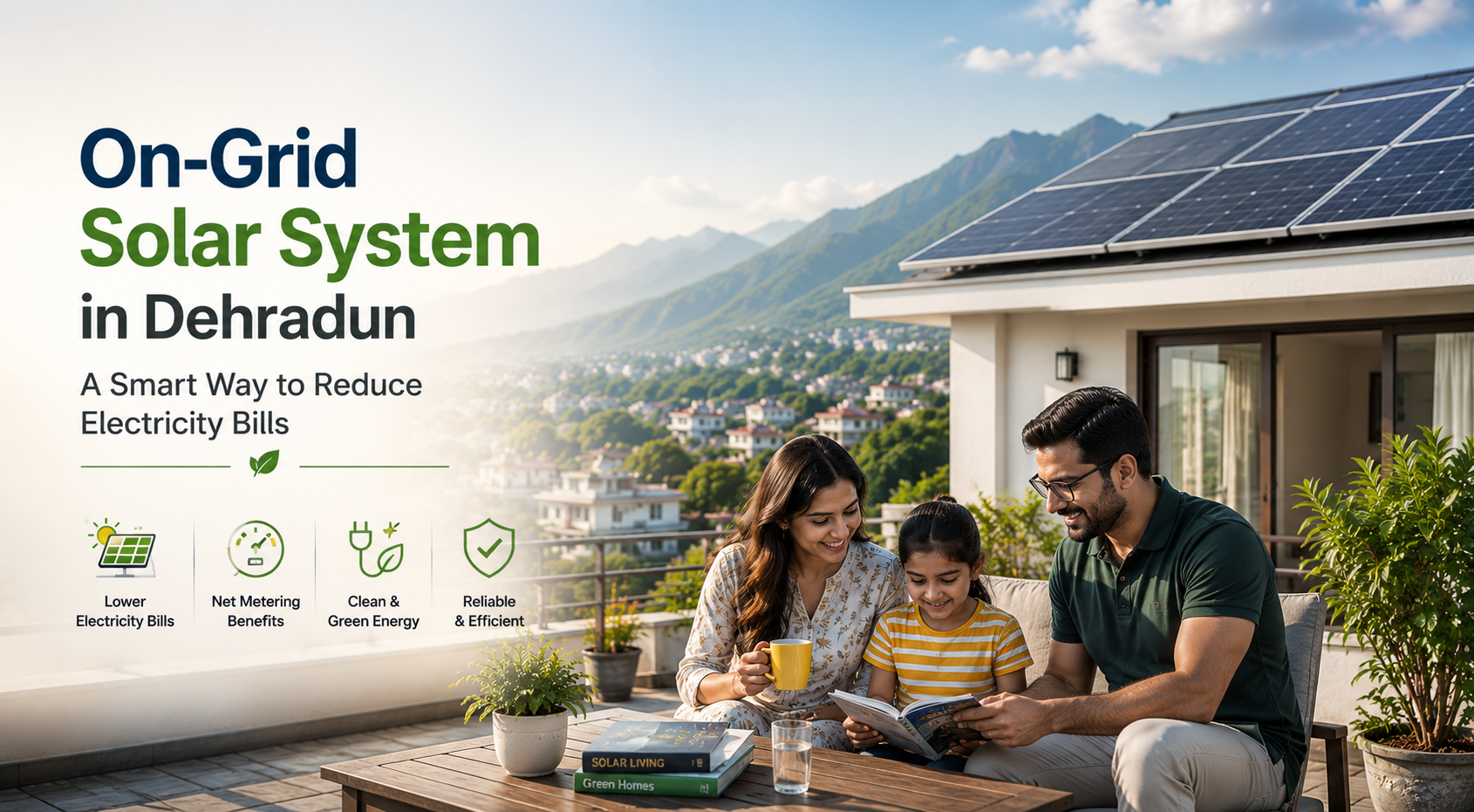
If you’ve looked at your electricity bill recently and felt it was getting harder to ignore, you’re not alone.
Across Dehradun, more homeowners are exploring rooftop solar as a way to reduce monthly electricity costs. What often surprises people is that most of these installations are not battery-based systems. Instead, they use something called an on-grid solar system.
When people first hear about solar, they usually imagine expensive batteries, complicated setups, and high maintenance. In reality, the most common solar system installed on homes today is much simpler.
An on-grid solar system allows you to generate electricity from sunlight while remaining connected to the electricity grid. During the day, your solar panels power your home. When solar production isn’t enough, electricity is automatically supplied from the grid.
For many households in Dehradun, this setup provides the perfect balance between affordability and savings.
Why Are So Many Homeowners Choosing On-Grid Solar?
A few years ago, solar installations were relatively uncommon. Today, it’s hard to drive through areas like Sahastradhara Road, GMS Road, Rajpur Road, Prem Nagar, or Clement Town without spotting solar panels on rooftops.
The reason is simple.
Electricity costs continue to rise, while solar technology has become more accessible and efficient.
Instead of paying for every unit of electricity from the grid, homeowners can generate a large portion of their daily energy needs directly from their rooftop.
For families with moderate to high electricity usage, the savings can become noticeable surprisingly quickly.
How Does an On-Grid Solar System Actually Work?
The idea is simpler than most people expect.
Solar panels installed on your roof capture sunlight and convert it into electricity. That electricity passes through an inverter and is then used to run appliances in your home.
If your system generates more electricity than you’re consuming at that moment, the excess power doesn’t go to waste. It is sent back to the electricity grid through a process called net metering.
Later, when your solar system isn’t producing enough power, such as during the evening, you can draw electricity from the grid as usual.
Everything happens automatically in the background.
Most homeowners don’t need to make any daily adjustments or monitor the system constantly.
The Feature That Makes On-Grid Solar So Attractive
If you ask solar owners what they like most about their system, many will mention net metering.
Think of it as a way of banking extra electricity.
During sunny afternoons, your home might be producing more power than it needs. Instead of losing that energy, it’s exported to the grid and recorded.
When you need electricity later, those exported units help offset your consumption.
This is one of the reasons on-grid systems often deliver better financial returns than people expect.
How Much Can You Actually Save?
This is usually the first question people ask.
The honest answer is that savings depend on your electricity consumption.
A household using 600 to 700 units per month will see very different results compared to a household using only 150 units.
For many families in Dehradun, a properly sized 5kW on-grid solar system can generate enough electricity to significantly reduce monthly power bills.
The exact numbers depend on factors such as roof orientation, shading, system quality, and energy usage patterns.
That’s why a site assessment is usually far more useful than generic online calculators.
Do You Need Batteries?
This is another common misconception.
Most homeowners don’t.
Because an on-grid system remains connected to the electricity network, it doesn’t require battery storage to function.
Removing batteries from the system keeps installation costs lower and reduces maintenance requirements.
For many urban properties with reliable grid electricity, this is one of the biggest advantages of choosing an on-grid setup.
Is Your Roof Suitable for Solar?
Many people assume their roof isn’t suitable until they actually have it inspected.
In reality, a large number of residential properties in Dehradun can support rooftop solar.
The most important factors are:
- Available roof space
- Sunlight exposure
- Shading from nearby buildings or trees
- Structural condition of the roof
A professional site survey can usually determine within a short time whether solar is a practical option for your property.
So, Is On-Grid Solar Worth It?
For many homeowners, the answer is yes.
The combination of lower installation costs, net metering benefits, minimal maintenance, and long-term electricity savings makes on-grid solar one of the most practical energy investments available today.
Every property is different, of course. A family living in a small house will have different requirements than a hotel, office, or commercial building.
That’s why the best place to start isn’t by comparing solar panel brands or system prices. It’s by understanding how much electricity your property consumes and how much energy your rooftop can generate.
Once you have those answers, deciding whether an on-grid solar system is the right choice becomes much easier.
Leave a Reply