

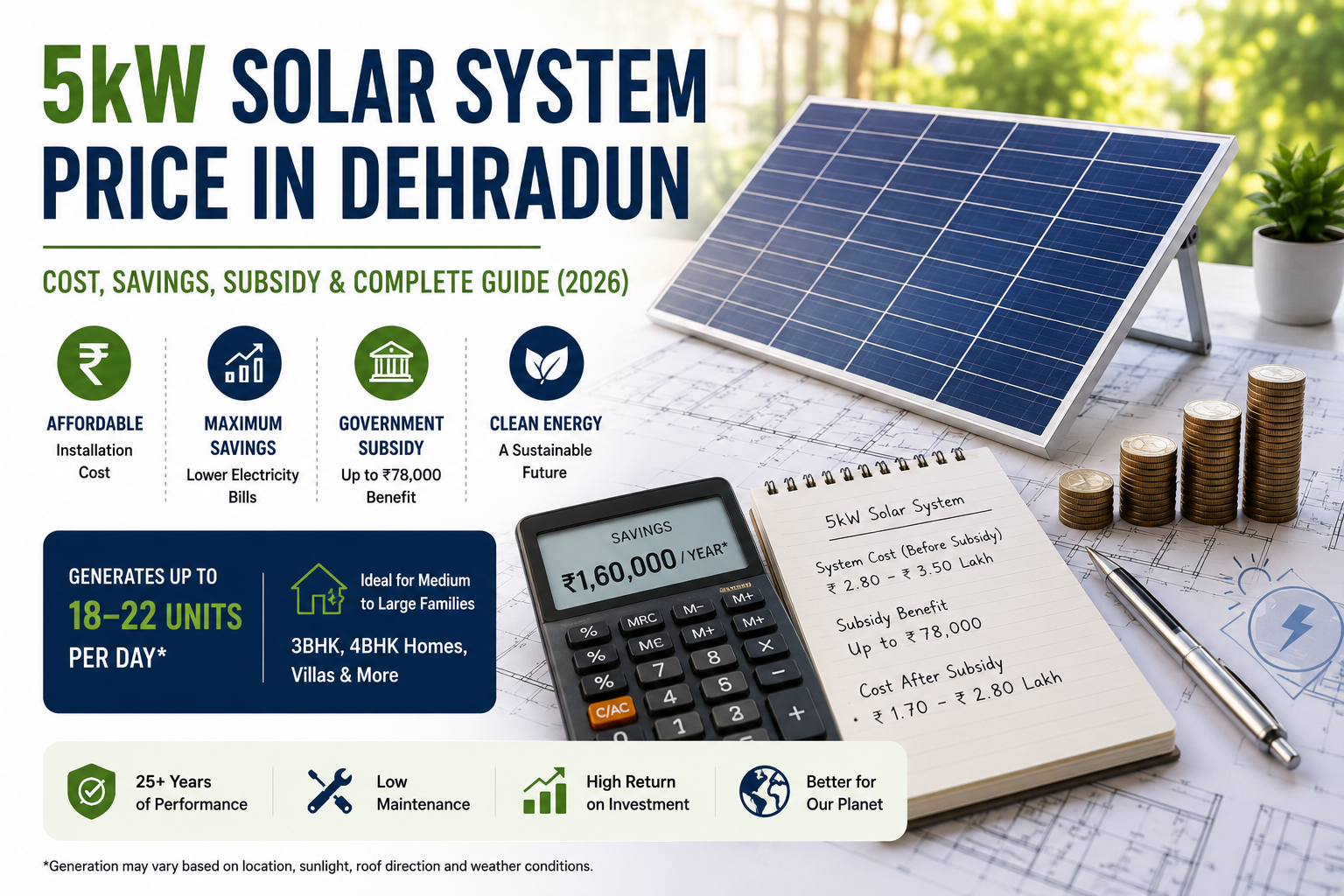
For many homeowners, a 5kW solar system represents the point where rooftop solar starts making a noticeable difference to electricity bills.
It’s one of the most commonly installed residential solar system sizes in Dehradun because it offers a strong balance between electricity generation and installation cost. For families with higher energy usage, especially those running air conditioners, water heaters, and multiple household appliances, a 5kW system often provides enough capacity to offset a significant portion of monthly electricity consumption.
As electricity costs continue to rise, more homeowners are beginning to view solar as a long-term investment rather than a simple home improvement project.
Why 5kW Systems Have Become So Popular
Not every home requires a large solar installation, but many households eventually outgrow smaller systems.
A 5kW system sits comfortably in the middle ground. It generates considerably more electricity than entry-level residential systems while remaining affordable enough for many homeowners.
For families living in 3BHK and 4BHK homes, villas, and larger residential properties, this system size is often a practical choice because it can support a wide range of everyday electrical requirements.
Rather than simply reducing electricity bills slightly, a properly designed 5kW system can make a substantial difference to overall energy expenses.
Understanding the Cost of a 5kW Solar System
One of the first things homeowners notice when researching solar is that pricing varies widely.
That’s because the final cost depends on several factors beyond the solar panels themselves.
Panel quality, inverter technology, rooftop conditions, mounting structures, and installation complexity all influence the overall investment.
In Dehradun, a standard on-grid 5kW solar system generally falls within the range of ₹2.8 lakh to ₹3.5 lakh before subsidy benefits.
Hybrid and off-grid systems typically cost more because they include battery storage and additional components.
The most accurate pricing always comes from a rooftop assessment because every property has unique requirements.
How Government Subsidies Change the Numbers
One of the reasons solar adoption has accelerated in recent years is the availability of government-supported rooftop solar programs.
These schemes help reduce the upfront cost of installation and improve the overall return on investment.
For eligible homeowners, subsidy benefits can significantly lower the effective cost of a 5kW solar system.
While subsidy structures may change over time, they continue to make rooftop solar more accessible for families that may have previously considered it too expensive.
Looking at Solar as a Long-Term Investment
Focusing only on the installation cost can sometimes hide the bigger picture.
A rooftop solar system continues generating electricity for decades. Every unit produced by your rooftop is a unit that doesn’t need to be purchased from the grid.
Under normal conditions, a 5kW solar system in Dehradun can typically generate around 18 to 22 units of electricity per day.
Over the course of a year, that adds up to thousands of units of electricity generated directly from sunlight.
For many homeowners, the long-term savings eventually exceed the original installation cost several times over.
This is one of the main reasons solar is increasingly viewed as an investment rather than an expense.
Is a 5kW System the Right Fit for Your Home?
A 5kW system is generally best suited for households with moderate to high electricity consumption.
Homes using multiple air conditioners, refrigerators, washing machines, televisions, kitchen appliances, and water pumps often benefit most from this system size.
Many families consuming between 500 and 700 units of electricity per month find that a 5kW installation aligns well with their energy requirements.
However, electricity usage patterns vary significantly from one household to another.
That’s why understanding actual consumption is usually more useful than selecting a system purely based on property size.
The Roof Space Requirement Is Often Smaller Than Expected
Many homeowners assume solar installations require enormous rooftops.
In reality, a 5kW system generally needs around 400 to 500 square feet of shadow-free roof space.
The exact requirement depends on panel efficiency, roof layout, and installation design.
A professional site assessment can quickly determine whether your rooftop has sufficient space and sunlight exposure for optimal performance.
Why On-Grid Systems Continue to Lead
Among residential solar installations, on-grid systems remain the most popular choice.
Because they stay connected to the electricity network, there is no need for expensive battery storage.
This keeps installation costs lower while allowing homeowners to benefit from net metering.
Hybrid systems offer backup power during outages, while off-grid systems are designed for locations without reliable grid access.
For most urban properties in Dehradun, on-grid systems provide the best combination of affordability and long-term savings.
Net Metering Makes Every Unit Count
One of the biggest financial advantages of rooftop solar is net metering.
When your solar system produces more electricity than your home is consuming, the excess power is exported to the electricity grid.
Instead of being wasted, that energy earns credits that help offset future electricity consumption.
This means the electricity generated during sunny daytime hours continues providing value even when household demand is lower.
For many homeowners, net metering plays a significant role in maximizing overall savings.
Frequently Asked Questions
How much electricity can a 5kW solar system generate?
Under normal operating conditions, a 5kW system can typically generate around 18–22 units of electricity per day.
How much roof space is required?
Most installations require approximately 400–500 square feet of shadow-free rooftop area.
Is a 5kW solar system suitable for a 3BHK house?
For many 3BHK homes consuming around 500–700 units per month, a 5kW system is often a suitable choice.
Can solar panels work during cloudy weather?
Yes. Electricity generation continues during cloudy conditions, although production is usually lower than on bright sunny days.
How long do solar panels last?
Most quality solar panels are designed to operate efficiently for 25 years or more.
For homeowners looking to make a meaningful reduction in electricity expenses, a 5kW solar system often represents one of the most practical residential solar investments available today. With rising energy costs, improving technology, and government support programs, rooftop solar continues to become a more attractive option for families across Dehradun.
Leave a Reply