

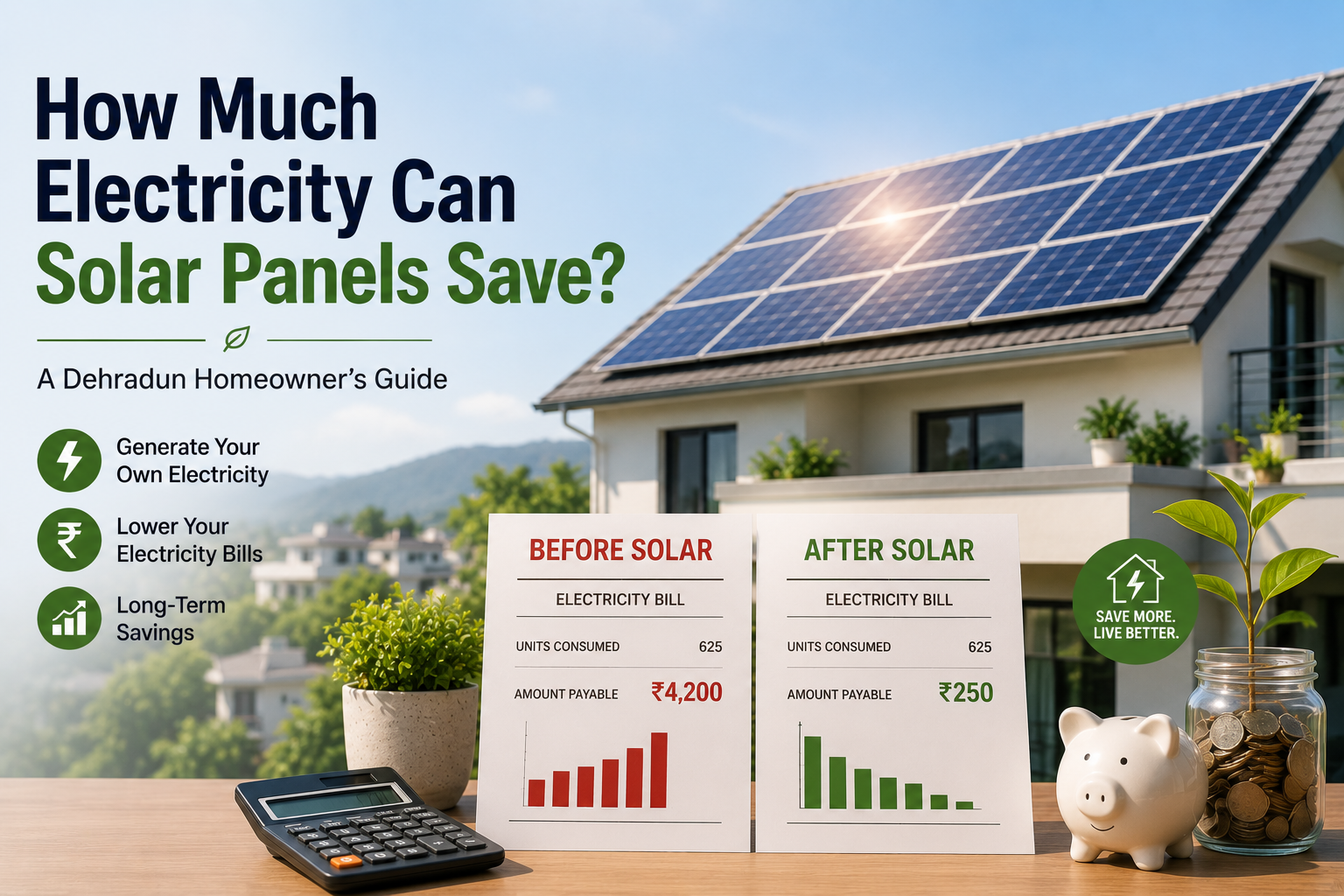
One of the biggest reasons homeowners consider solar is simple: lower electricity bills.
But before investing in a rooftop solar system, most people want to know how much electricity it can actually save.
The answer depends on factors such as your household’s energy consumption, the size of the solar system, roof conditions, and how much sunlight your property receives throughout the year.
The good news is that Dehradun enjoys favorable sunlight conditions for solar power generation, making rooftop solar a practical option for many residential properties.
Rather than looking at solar as a way to eliminate electricity bills overnight, it is often more useful to think about how much of your monthly electricity consumption can be replaced by energy generated directly from your rooftop.
How Solar Panels Reduce Electricity Consumption
Every unit of electricity generated by your solar panels is a unit you do not need to purchase from the grid.
During the daytime, the electricity produced by the solar system is used to power appliances, lighting, fans, refrigerators, air conditioners, and other household equipment.
Because your home is using solar energy first, your dependence on grid electricity decreases.
For many homeowners, this translates directly into lower monthly electricity bills.
If the system generates more electricity than the home is consuming, the excess energy can often be exported back to the grid through net metering, creating additional value.
Why Dehradun Is Well Suited for Rooftop Solar
Location plays an important role in determining how much electricity a solar system can generate.
Fortunately, Dehradun receives good sunlight during most months of the year, allowing rooftop solar systems to operate efficiently for long periods.
While weather conditions and seasonal variations naturally affect generation, homeowners generally have access to enough sunlight to make solar a worthwhile long-term investment.
This is one of the reasons rooftop solar adoption continues to grow across the city.
Understanding Savings Through Real-Life Usage Patterns
Not every household consumes electricity in the same way.
A small family using basic household appliances will have different energy requirements compared to a larger household running multiple air conditioners and high-power equipment.
Homes consuming around 350 to 450 units per month often find that a 3kW solar system can offset a significant portion of their electricity usage.
Larger households consuming 600 to 700 units each month may benefit more from a 5kW system, while properties with very high consumption often require larger installations.
The key point is that solar savings are directly linked to how closely the system size matches your actual electricity consumption.
Looking Beyond Monthly Savings
Many homeowners focus only on the immediate reduction in electricity bills.
While monthly savings are certainly important, the long-term impact is often much larger.
A rooftop solar system is designed to generate electricity for decades.
Over time, the savings accumulate year after year while electricity prices continue to rise.
For this reason, solar is increasingly viewed as an investment rather than an expense.
The electricity generated over the lifespan of a solar system can often be worth several times more than the original installation cost.
Factors That Influence Solar Savings
Although solar can provide substantial savings, results vary from one property to another.
Several factors affect overall performance.
The size of the solar system naturally has a major impact because larger systems generate more electricity.
Roof orientation and sunlight exposure also matter. Shading from nearby buildings, trees, water tanks, or other structures can reduce generation.
Panel quality, inverter performance, and regular maintenance all contribute to how efficiently the system operates over time.
Even homeowner behavior plays a role, as households that consume more electricity during daylight hours often benefit more from solar generation.
Why Net Metering Makes a Difference
One of the biggest advantages of modern rooftop solar systems is net metering.
When the solar system produces more electricity than the home is currently using, the excess energy is exported to the grid.
Instead of losing that electricity, homeowners receive credits that can help offset future consumption.
This means that electricity generated during sunny daytime hours continues providing value even when the household is using more power during the evening.
For many homeowners, net metering significantly improves overall savings.
Can Solar Eliminate Electricity Bills Completely?
In some situations, a properly sized solar system can offset most or nearly all of a household’s electricity consumption.
However, every property is different.
Actual savings depend on electricity usage patterns, seasonal changes, system size, and net metering benefits.
Rather than aiming for a zero bill, most homeowners focus on reducing their dependence on grid electricity as much as possible while maximizing long-term savings.
Is Solar Worth It for Homeowners in Dehradun?
For many households, the answer is yes.
Good sunlight availability, government subsidy programs, net metering support, and rising electricity prices have made rooftop solar one of the most practical home upgrades available today.
The exact amount you save depends on your property’s energy requirements, but the overall trend is clear: a well-designed solar system can significantly reduce electricity expenses while providing long-term value for decades.
Frequently Asked Questions
How much electricity can a rooftop solar system save?
The savings depend on your electricity consumption and system size. A properly sized system can offset a substantial portion of a household’s monthly electricity usage.
Does solar work during cloudy weather?
Yes. Solar panels continue generating electricity during cloudy conditions, although output is typically lower than on bright sunny days.
Can solar panels reduce electricity bills significantly?
For many homeowners, yes. A well-designed system can reduce dependence on grid electricity and lower monthly energy costs considerably.
What affects solar savings the most?
System size, sunlight availability, roof conditions, shading, electricity consumption patterns, and net metering benefits all influence overall savings.
How long do solar panels continue generating electricity?
Most quality solar panels are designed to operate efficiently for 25 years or more.
Leave a Reply