

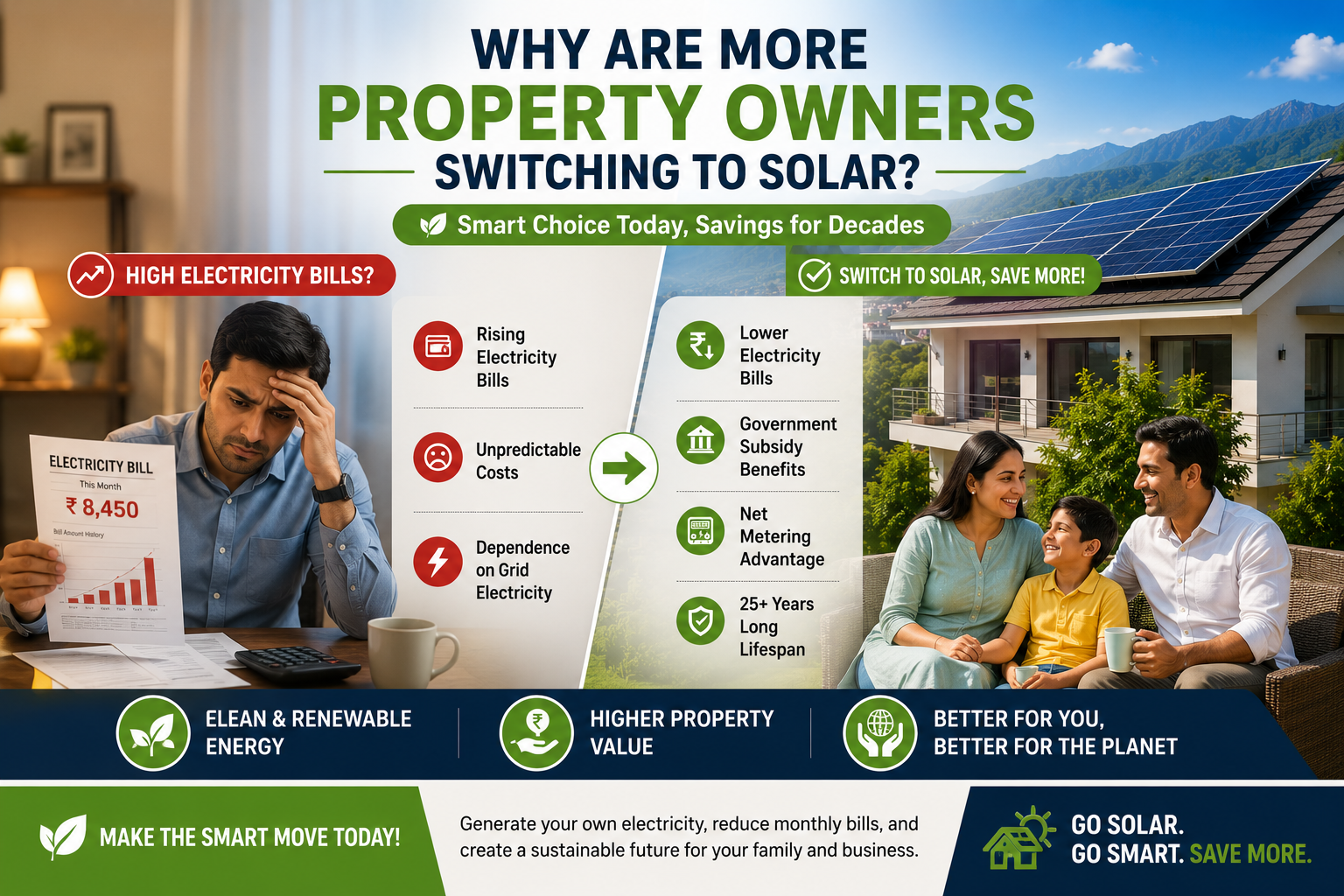
If you’ve noticed your electricity bills increasing year after year, you’re not alone. Many homeowners and businesses across Dehradun are looking for ways to reduce their monthly energy costs without compromising on their power needs.
That’s one of the reasons rooftop solar has become increasingly popular in recent years.
Instead of relying entirely on electricity from the grid, a rooftop solar system allows you to generate your own power using the sunlight that falls on your roof every day. Whether you own a house, office, shop, school, hotel, or factory, solar can help reduce electricity expenses and provide long-term savings.
With abundant sunlight throughout most of the year, Dehradun is well suited for rooftop solar installations, making it an attractive option for property owners who want to invest in a cleaner and more cost-effective energy solution.
What Is a Rooftop Solar System?
A rooftop solar system is a power generation system installed on the roof of a building. It uses solar panels to capture sunlight and convert it into electricity that can be used within the property.
The electricity generated can power lights, fans, air conditioners, appliances, computers, and other electrical equipment. Depending on the size of the system, solar can offset a significant portion of your monthly electricity consumption.
For many property owners, the biggest advantage is simple: lower electricity bills month after month.
Why More People in Dehradun Are Choosing Rooftop Solar
A few years ago, rooftop solar was something most people only heard about. Today, it’s becoming a common sight across residential colonies, commercial buildings, schools, and institutions in Dehradun.
There are several reasons behind this growing popularity:
- Lower monthly electricity bills
- Government subsidy benefits for eligible systems
- Protection against rising electricity costs
- Minimal maintenance requirements
- Clean and renewable energy generation
- Increased property value
- Equipment life of 25 years or more
For many families and businesses, rooftop solar is no longer viewed as an expense but as a long-term investment that continues to generate savings for decades.
How Does a Rooftop Solar System Work?
The process is surprisingly simple.
Solar panels installed on the roof absorb sunlight and generate electricity in the form of direct current (DC). This electricity then passes through a solar inverter, which converts it into alternating current (AC) that can be used by household appliances and electrical equipment.
Any electricity generated is immediately available for use within the property. If your system is connected through net metering and produces more electricity than you consume, the excess power can be exported back to the grid.
This allows homeowners and businesses to maximize the value of the electricity their solar system generates.
Is Your Roof Suitable for Solar Panels?
One of the first questions most people ask is whether their roof can support a solar installation.
In many cases, the answer is yes.
A rooftop is generally suitable if it:
- Receives good sunlight throughout the day
- Has limited shading from nearby buildings or trees
- Has adequate structural strength
- Offers enough available space for the required system size
Before recommending a system, a professional site survey should be carried out to assess roof orientation, available area, shading conditions, and expected energy generation.
This helps ensure the system performs efficiently and delivers the expected savings.
Types of Rooftop Solar Systems
Not every property has the same energy requirements. That’s why rooftop solar systems are available in different configurations.
On-Grid Rooftop Solar System
An on-grid system is connected directly to the electricity network.
This is the most popular option for homes and businesses in Dehradun because it offers:
- Lower installation costs
- Net metering benefits
- No battery maintenance
- Faster return on investment
For most urban properties, an on-grid system is the preferred choice.
Hybrid Rooftop Solar System
A hybrid system combines solar panels with battery storage.
Benefits include:
- Backup power during outages
- Better energy management
- Increased energy security
- Reduced dependence on the grid
Off-Grid Rooftop Solar System
An off-grid system operates independently and relies on batteries to store electricity.
It is commonly used in locations where grid power is unavailable or unreliable.
Benefits include:
- Complete energy independence
- Reliable power in remote locations
The best system depends on your electricity consumption, budget, and backup requirements.
How Much Can You Save with Rooftop Solar?
The amount you save depends on your electricity usage and the size of your solar system.
For example, a household consuming around 600 to 700 units of electricity per month may benefit from a 5kW rooftop solar system.
Under normal conditions, a properly installed 5kW system in Dehradun can generate approximately 18 to 22 units of electricity per day.
Over time, this can reduce a significant portion of monthly electricity expenses and generate substantial savings throughout the life of the system.
Actual savings depend on factors such as:
- System size
- Electricity tariff
- Roof orientation
- Sunlight availability
- Net metering benefits
A site assessment and electricity bill review can provide a much more accurate estimate of potential savings.
Rooftop Solar for Homes
Residential rooftop solar systems are suitable for:
- Independent houses
- Villas
- Farmhouses
- Residential societies
Many homeowners choose solar because it helps create more predictable energy costs while reducing monthly expenses.
With modern technology and government incentives, solar has become far more accessible than it was a few years ago.
Rooftop Solar for Businesses
Commercial buildings often have large rooftops that can generate significant amounts of electricity.
Common applications include:
- Offices
- Schools
- Hospitals
- Hotels
- Warehouses
- Factories
- Retail stores
For businesses, reducing electricity costs can have a direct impact on operating expenses. That’s why many commercial properties are now incorporating solar as part of their long-term energy strategy.
Government Subsidy for Rooftop Solar
Government-supported rooftop solar programs help make solar more affordable for homeowners.
Depending on current guidelines and eligibility criteria, subsidies may reduce the initial investment required for installation.
Because subsidy policies can change over time, it’s always advisable to check the latest requirements before making a decision.
Many homeowners find the process confusing at first, especially when documentation and approvals are involved. Understanding the available options beforehand can help make the transition smoother.
Net Metering: One of Solar’s Biggest Advantages
Net metering is often one of the most attractive benefits of an on-grid solar system.
When your solar panels generate more electricity than your property consumes, the excess power is exported back to the grid.
In return, you receive credits that help offset future electricity consumption.
This improves the overall return on investment and allows homeowners to make full use of the electricity their system generates.
What Does the Installation Process Look Like?
Installing a rooftop solar system is generally a straightforward process.
A typical project includes:
1. Site Survey
The property is inspected and energy requirements are evaluated.
2. System Design
A customized solar solution is designed based on the available roof space and electricity consumption.
3. Proposal and Consultation
Expected generation, system specifications, and estimated savings are discussed.
4. Installation
Solar panels, inverter, and mounting structures are installed by trained technicians.
5. Testing and Commissioning
The system is tested to ensure everything operates correctly.
6. Ongoing Support
Periodic maintenance and support help keep the system performing efficiently.
Frequently Asked Questions
How long do rooftop solar panels last?
Most high-quality solar panels are designed to operate for 25 years or more.
Do rooftop solar systems work during cloudy weather?
Yes. Solar panels continue generating electricity during cloudy conditions, although output may be lower than on bright sunny days.
How much maintenance is required?
Very little. Occasional cleaning and periodic inspections are generally enough to maintain good performance.
Can I install solar panels on an existing building?
Yes. Most existing residential and commercial properties can accommodate rooftop solar after a site assessment.
Your roof receives sunlight every day, whether you’re using it or not. Rooftop solar simply allows you to turn that unused space into a source of long-term savings.
For many property owners in Dehradun, solar has become a practical way to reduce electricity expenses while investing in a cleaner and more sustainable future. The right system depends on your energy consumption, roof space, and long-term goals, which is why a proper assessment is always the best first step.
If you’re exploring rooftop solar installation in Dehradun, understanding your options today can help you make a more informed decision and potentially save thousands on electricity costs over the years ahead.
over the years ahead.
Leave a Reply