

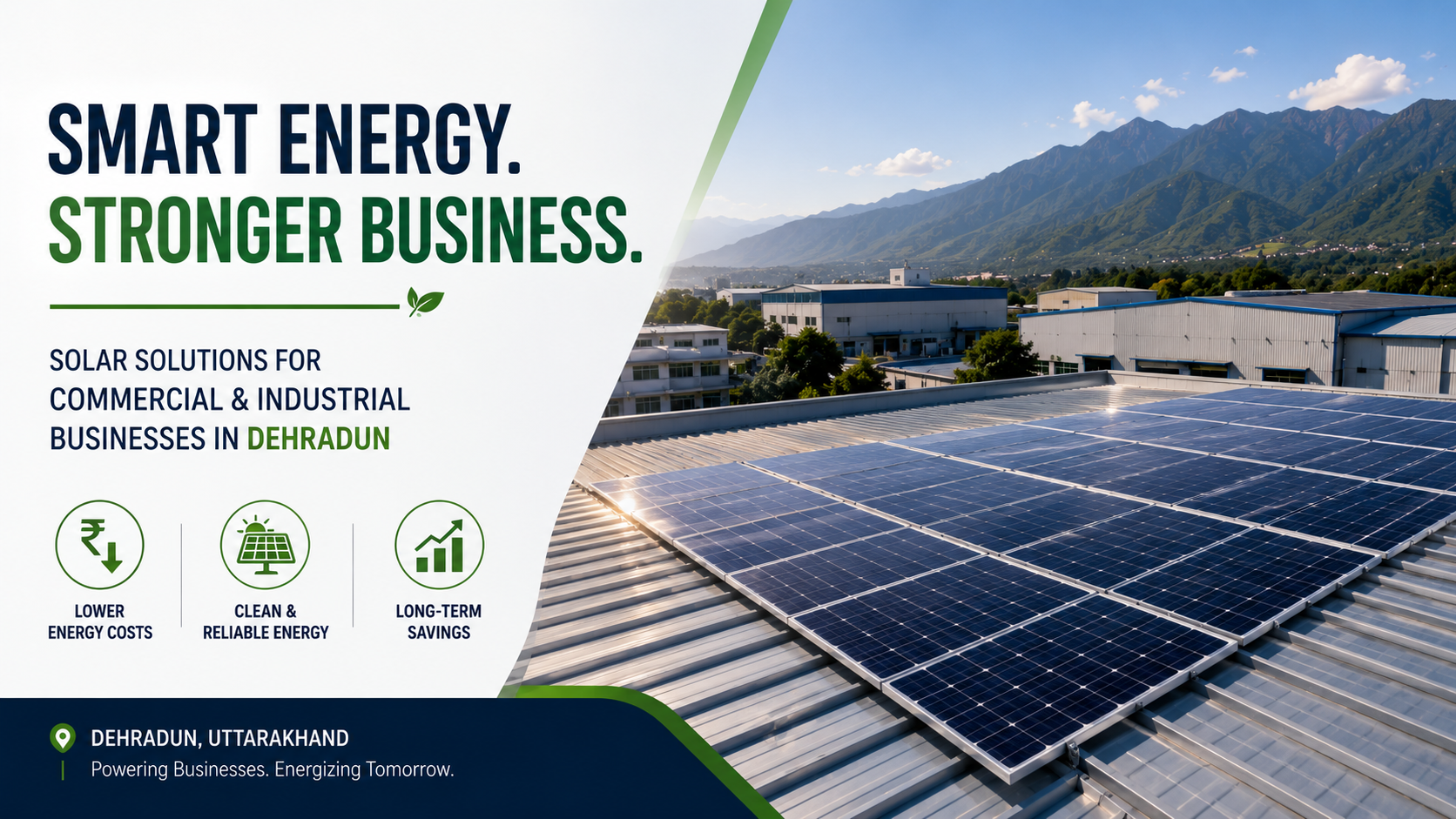
For many businesses, electricity is one of the largest ongoing operating expenses.
Whether it’s a manufacturing unit, warehouse, hotel, hospital, commercial complex, educational institution, or office building, energy costs directly affect profitability. As electricity prices continue to rise, businesses are increasingly looking for long-term solutions that can help reduce operational expenses without affecting productivity.
This is one of the main reasons commercial and industrial solar installations have grown rapidly over the last few years.
By generating electricity directly from sunlight, businesses can reduce their dependence on grid power, lower operating costs, and create long-term savings that continue for decades.
Why Businesses Are Turning to Solar
Every business looks for ways to improve efficiency and control expenses.
Unlike many cost-cutting measures that eventually reach a limit, solar continues generating value year after year. Once installed, a solar system produces electricity during daylight hours, helping reduce the amount of energy purchased from the grid.
For organizations with significant daytime electricity consumption, the financial benefits can be substantial.
At the same time, solar provides protection against future electricity tariff increases, helping businesses achieve greater predictability in their energy expenses.
Commercial vs Industrial Solar Projects
While the technology behind both systems is similar, commercial and industrial projects often have different objectives.
Commercial solar systems are commonly installed on offices, hotels, hospitals, shopping complexes, educational institutions, and retail properties. The primary goal is usually to reduce electricity bills and improve operational efficiency.
Industrial solar projects are typically designed for factories, manufacturing facilities, processing plants, warehouses, and industrial campuses that consume significantly larger amounts of electricity.
Because energy requirements vary from one business to another, every project should be designed around actual consumption patterns rather than a standard package.
Why Rooftop Solar Is Popular Among Businesses
Many commercial and industrial buildings already have one valuable resource that often goes unused: rooftop space.
Factories, warehouses, office buildings, schools, and hotels frequently have large roofs exposed to sunlight throughout the day.
Rooftop solar allows businesses to convert this unused space into a productive asset that generates electricity and reduces operating costs.
For many organizations, it is one of the most efficient ways to improve the value of existing infrastructure.
Ground-Mounted Solar for Larger Projects
Not every solar project needs to be installed on a rooftop.
Businesses with access to open land may choose ground-mounted solar systems, particularly when larger capacities are required.
Ground-mounted installations offer greater flexibility in system design and can often be expanded more easily as future energy requirements grow.
These projects are commonly used by industrial facilities, institutions, and organizations with substantial electricity demands.
How Solar Creates Long-Term Financial Value
The real value of solar is not measured by the first month’s savings.
It is measured by the electricity generated over the entire life of the system.
A quality commercial or industrial solar plant is designed to operate for decades. During that time, it can offset a significant portion of a company’s electricity expenses.
As electricity costs increase over time, every unit generated by the solar system becomes more valuable.
This is why many businesses view solar not as an expense but as a long-term asset.
Which Industries Benefit the Most?
Solar can be valuable across a wide range of sectors.
Manufacturing facilities often benefit because machinery and production processes consume large amounts of electricity.
Warehouses typically have large rooftops that are ideal for solar installations.
Hotels and resorts operate energy-intensive facilities such as kitchens, air conditioning systems, and guest services.
Hospitals require continuous power for critical operations, while educational institutions consume electricity throughout the day across multiple buildings.
In many cases, the higher the daytime electricity consumption, the stronger the potential return from solar.
The Importance of Proper System Design
A successful solar project starts long before installation begins.
Every property has different energy requirements, operating schedules, available space, and future expansion plans.
A professional assessment helps determine the most suitable system size, equipment configuration, and installation approach.
The goal isn’t simply to install as many panels as possible.
It’s to create a system that delivers reliable performance, strong savings, and long-term value.
Modern Solar Technology Has Improved Significantly
Solar technology has advanced rapidly over the past few years.
Today’s commercial and industrial systems are more efficient, more reliable, and capable of generating more electricity from the same amount of space than earlier generations.
Improvements in solar panels, inverters, monitoring systems, and engineering practices have made solar projects more attractive for businesses of all sizes.
These advancements continue to improve both performance and return on investment.
Net Metering and Commercial Solar
Net metering can further improve the economics of a solar project.
When a solar system generates more electricity than the property is currently consuming, the excess energy can often be exported back to the grid.
Those exported units can help offset future electricity consumption, increasing overall savings and improving financial returns.
For many businesses, net metering plays an important role in maximizing the value of a solar installation.
Looking Beyond the Installation Cost
One of the biggest mistakes businesses make is focusing only on the initial investment.
While installation cost is important, it represents only one part of the financial picture.
The electricity generated by the system over the next twenty-five years often delivers far greater value than the original purchase price.
When evaluated as a long-term infrastructure investment, solar frequently becomes one of the most attractive opportunities available for reducing operating expenses.
Is Commercial Solar Worth It?
For many businesses, the answer is yes.
Rising electricity prices, improving solar technology, large rooftop availability, and long system lifespans have created a strong case for solar adoption.
The exact financial benefits depend on energy consumption, system size, installation quality, and local electricity tariffs.
However, businesses that consume substantial electricity during the day often find that solar delivers both immediate savings and long-term value.
Frequently Asked Questions
Can factories install rooftop solar systems?
Yes. Many factories have large rooftops that are well suited for solar installations.
Is solar suitable for warehouses?
Yes. Warehouses often have extensive roof space and consistent daytime energy requirements, making them excellent candidates for solar.
What’s the difference between rooftop and ground-mounted solar?
Rooftop systems are installed on buildings, while ground-mounted systems are installed on open land and are commonly used for larger projects.
How long do commercial solar systems last?
Most quality solar systems are designed to operate efficiently for 25 years or more.
Can solar significantly reduce business electricity bills?
Yes. A properly designed system can offset a substantial portion of a business’s electricity consumption, creating meaningful long-term savings.
Leave a Reply