
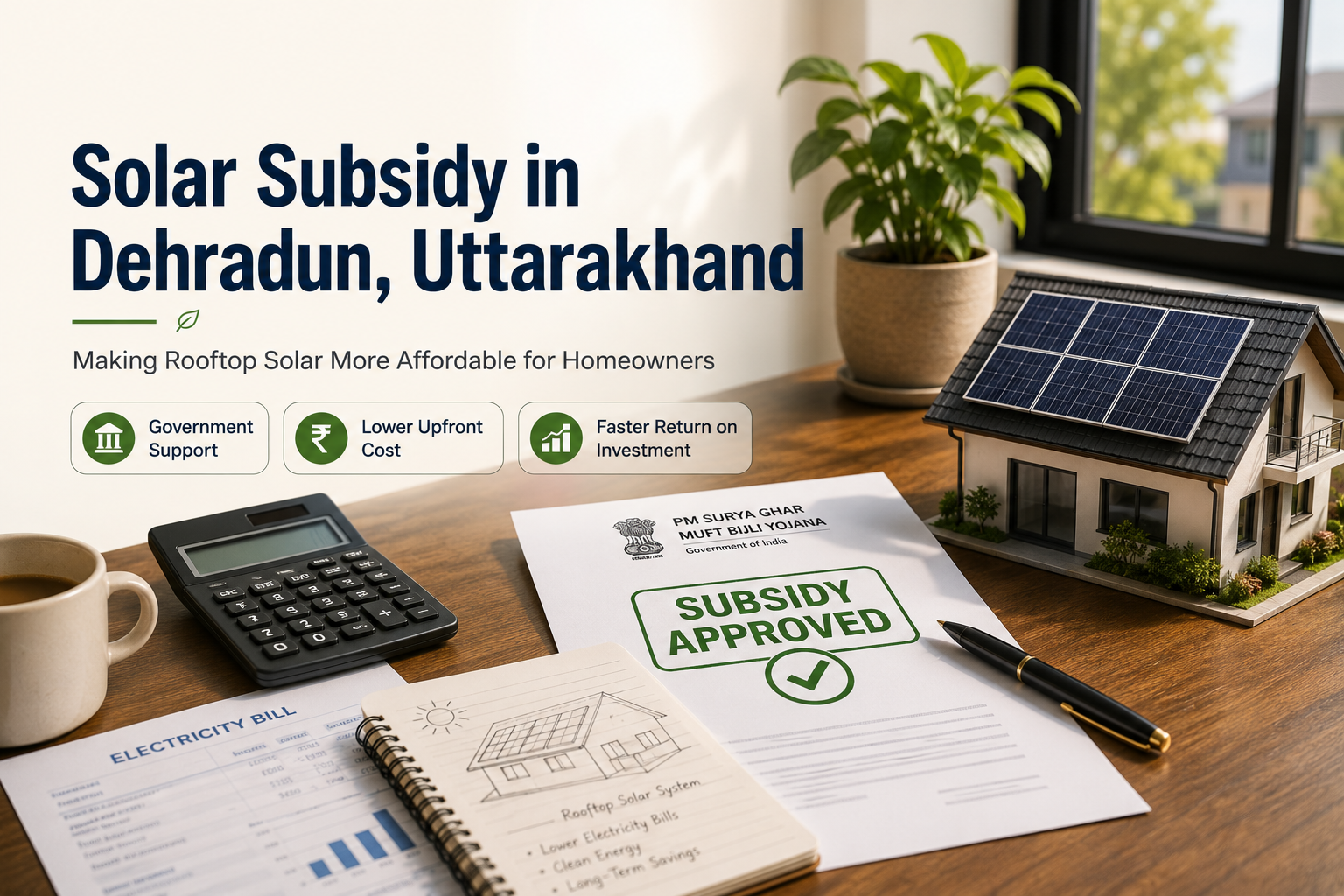
One of the biggest reasons many homeowners delay installing rooftop solar is the initial investment.
While solar can deliver significant long-term savings, the upfront cost often feels like a barrier. This is exactly why government-supported solar subsidy programs have become such an important part of India’s push toward clean energy adoption.
For homeowners in Dehradun and across Uttarakhand, these subsidy programs can reduce installation costs and make rooftop solar far more affordable than it was just a few years ago.
Combined with rising electricity prices and the growing popularity of net metering, solar is becoming an increasingly attractive option for residential properties.
Why Solar Subsidies Exist
The government’s goal is simple: encourage more households to generate their own electricity.
By offering financial assistance for rooftop solar installations, subsidy programs help reduce dependence on traditional power sources while supporting the adoption of renewable energy.
For homeowners, the benefit is straightforward. A portion of the installation cost is covered through government support, lowering the amount that needs to be invested upfront.
This makes solar more accessible and improves the overall return on investment.
Solar Subsidy Availability in Dehradun
Homeowners in Dehradun are eligible to apply for rooftop solar subsidy benefits under national residential solar programs such as PM Surya Ghar Muft Bijli Yojana.
These schemes are designed specifically for residential consumers and aim to make rooftop solar installations more affordable for households.
As interest in solar continues to grow across Uttarakhand, more families are using these subsidy benefits to reduce installation costs and accelerate their savings.
Understanding How Much Subsidy You Can Receive
The subsidy amount depends primarily on the size of the solar system being installed.
Smaller residential systems receive support based on their capacity, while larger residential installations are generally covered up to a specified limit under current guidelines.
For many homeowners, the subsidy can reduce the overall investment by tens of thousands of rupees, making a noticeable difference in affordability.
Because subsidy structures can change over time, it is always worth checking the latest government guidelines before making a final decision.
Why Subsidies Matter More Than Ever
Electricity costs continue to rise, and many households are consuming more power than ever before.
Air conditioners, home offices, kitchen appliances, water heaters, and electronic devices all contribute to growing monthly electricity bills.
Solar subsidies help bridge the gap between the upfront cost of installation and the long-term financial benefits of generating your own electricity.
For many families, government support is what turns solar from a future consideration into an immediate opportunity.
Looking Beyond the Subsidy Amount
While the subsidy is certainly important, it is only one part of the overall value of a solar system.
A rooftop solar installation continues generating electricity for decades.
Every unit produced by your rooftop reduces the amount of electricity that needs to be purchased from the grid.
When long-term bill savings are combined with subsidy benefits, many homeowners find that the overall financial advantage is significantly larger than the subsidy amount alone.
This is why solar is increasingly viewed as a long-term investment rather than a household expense.
Who Can Benefit From Residential Solar Subsidies?
In most cases, subsidy programs are designed for residential property owners who meet the eligibility requirements of the scheme.
Applicants generally need an active electricity connection and suitable rooftop space for installation.
Commercial buildings and business properties are usually covered under different policies and may not qualify for residential subsidy benefits.
Because eligibility requirements can evolve, homeowners should always verify the latest guidelines before beginning the application process.
Understanding the Application Process
Many people assume applying for solar subsidy is complicated.
In reality, the process has become much more streamlined than it was in the past.
Homeowners typically begin by registering through the official rooftop solar portal and providing their electricity connection details.
Once the application is approved, the solar system is installed and inspected. After verification and completion of the required procedures, the subsidy amount is transferred according to the applicable program guidelines.
While the exact timeline can vary, the process is generally designed to be straightforward for residential consumers.
How Net Metering Increases Solar Savings
One of the biggest advantages of rooftop solar is that the electricity generated doesn’t need to be used immediately.
When your system produces more electricity than your home is consuming, the excess energy can be exported to the electricity grid through net metering.
Those exported units earn credits that help offset future electricity usage.
This means homeowners continue receiving value from the electricity generated even when household demand is lower.
For many families, net metering plays a major role in maximizing the overall return on investment.
Why Rooftop Solar Makes Sense in Dehradun
Dehradun’s climate offers favorable conditions for residential solar generation throughout much of the year.
Combined with government incentives, modern solar technology, and growing awareness about renewable energy, rooftop solar has become a practical option for many homeowners.
Modern solar panels are designed to operate efficiently for 25 years or more, require relatively little maintenance, and can provide substantial long-term savings when properly sized and installed.
As electricity prices continue to increase, many homeowners are finding that the question is no longer whether solar is worth considering, but how soon they should make the switch.
Frequently Asked Questions
Is solar subsidy available in Dehradun?
Yes. Eligible residential homeowners in Dehradun can apply for rooftop solar subsidy benefits under current government programs.
What is the maximum subsidy available?
The amount depends on prevailing government guidelines and system size. Current residential schemes generally provide support up to specified limits for eligible installations.
Can commercial properties receive residential solar subsidy?
Residential subsidy programs are generally intended for homeowners and residential properties rather than commercial buildings.
How long does the subsidy process take?
The timeline depends on application approval, installation, inspection, and verification procedures.
Is solar still worth installing after subsidy?
For many households, yes. The combination of subsidy support, reduced electricity bills, net metering benefits, and long system lifespan can make rooftop solar a valuable long-term investment.
Leave a Reply